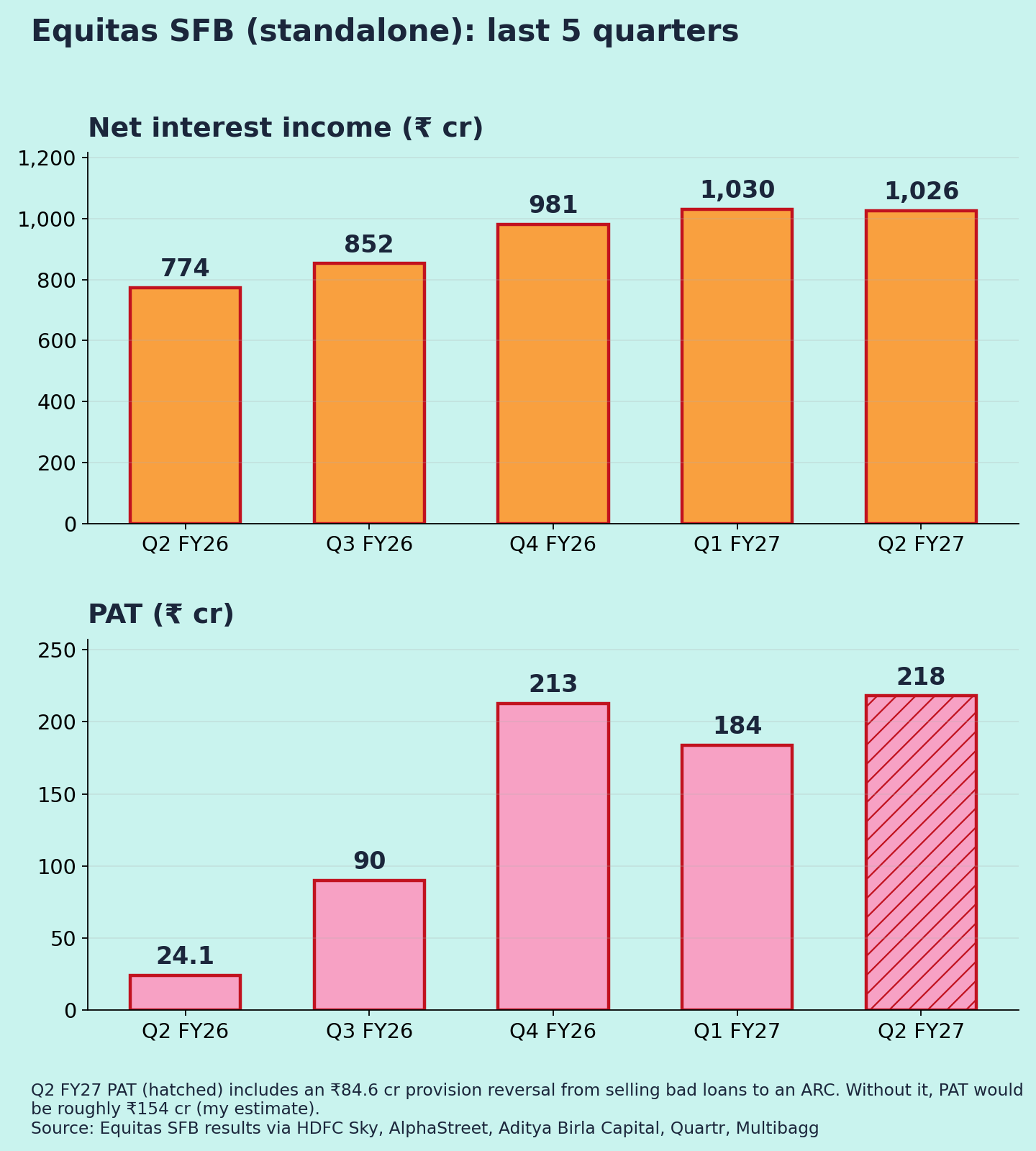
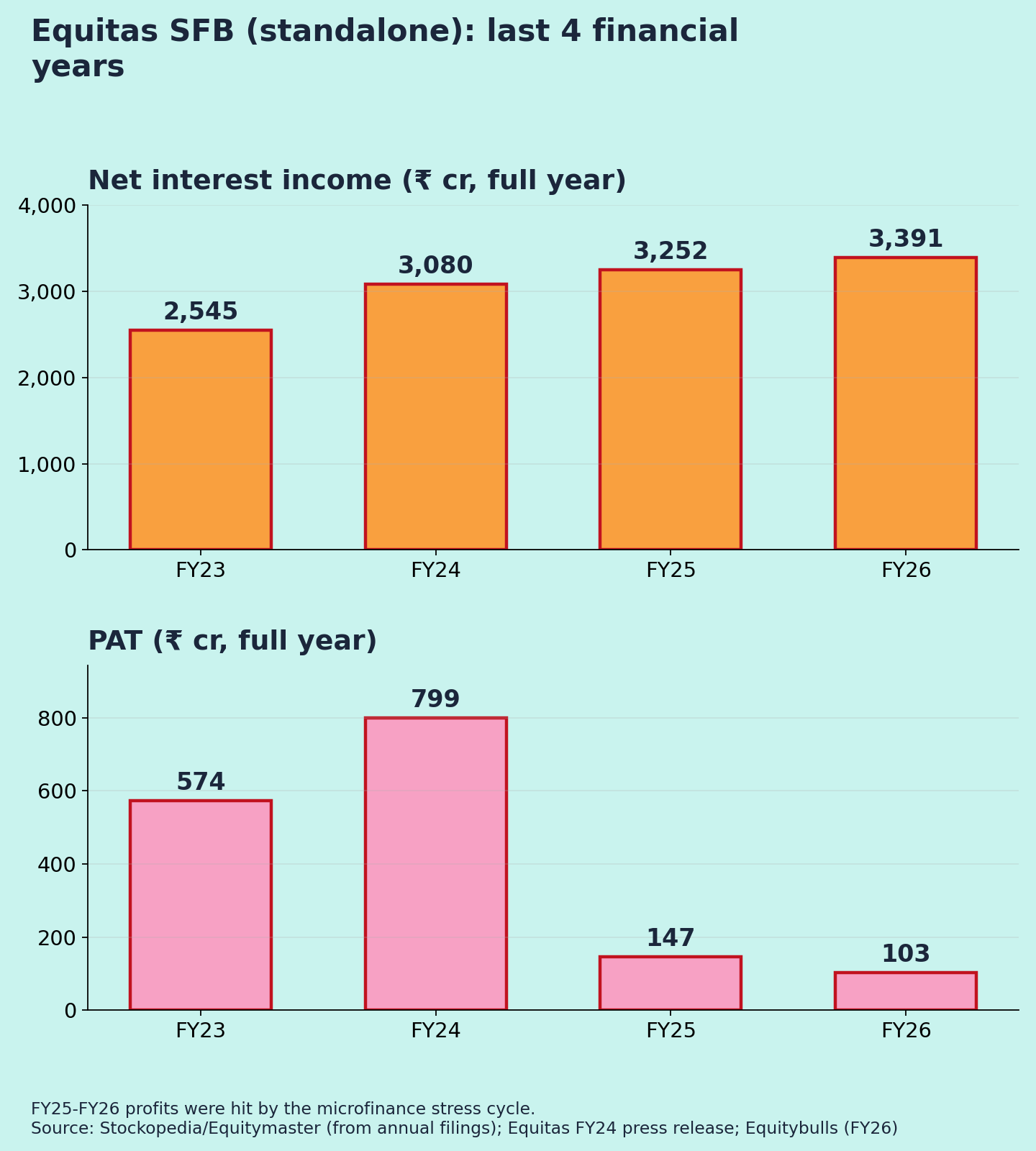
All figures standalone (the basis the bank reports on), ₹ crore unless stated. Results and the MD & CEO's resignation were both announced on 29 Oct 2026 [1][6]. YoY/QoQ % and the "excluding reversal" estimate are my calculations.
| Metric | Q2 FY27 | YoY | QoQ |
| Gross advances | 50,694 | +29.6% | +6.4% |
| Deposits | 52,483 | +19.0% | +7.0% |
| NII | 1,026 | +32.7% | −0.3% |
| NIM | 6.69% | 6.29% | 7.24% |
| Other income | 292 | +27.5% | +17% |
| Operating profit (PPOP) | 402 | +67.3% | −0.6% |
| Provisions | 115 | −44% | −29% |
| Credit cost | 0.94% | – | 1.37% |
| PAT | 218 | 9x | +18.8% |
| GNPA / NNPA | 2.29% / 0.70% | 2.92% / 0.98% | 2.42% / 0.71% |
| PCR (excl. / incl. write-offs) | 70.1% / 86.7% | 66.9% / – | 71.0% / – |
| CASA | 26% | – | – |
| CD ratio | ~97% | ~89% | ~97% |
| Cost-to-income | 69.4% | 75.9% | 68.4% |
| CRAR | 20.92% | – | 19.44% |
| RoA / RoE | 1.31% / 13.5% | 0.18% / 1.65% | 1.18% / – |
For ratio rows, the YoY and QoQ columns show the prior-period value.
Why the stock fell despite record profit (interpretation)
- The CEO resigned. Founder and MD & CEO P N Vasudevan stepped down on results day [6]. A successor needs RBI approval [8]. Losing the founder creates uncertainty about strategy and leadership. The market may also read the exit as confirming the concern, even though no wrongdoing has been shown (my view).
- The core quarter was softer than the headline. NII was flat QoQ, NIM fell 55 bps, and operating profit was flat [1][2]. A good part of the PAT jump came from lower provisions, including an ₹84.6 cr reversal after selling bad loans to an ARC (asset reconstruction company) [2]. Without that reversal, PAT would have been roughly ₹154 cr, about 16% lower QoQ (my rough estimate at the reported 24% tax rate).
The stock closed at ₹57.17 (−12.2%) on 29 Oct after touching the 20% lower circuit at ₹52.11 [7].
Quality of earnings
Base effect: Q2 FY26 was a crisis-era quarter (PAT ₹24 cr) because of the microfinance stress [3]. So the 9x YoY jump is mostly a weak base.
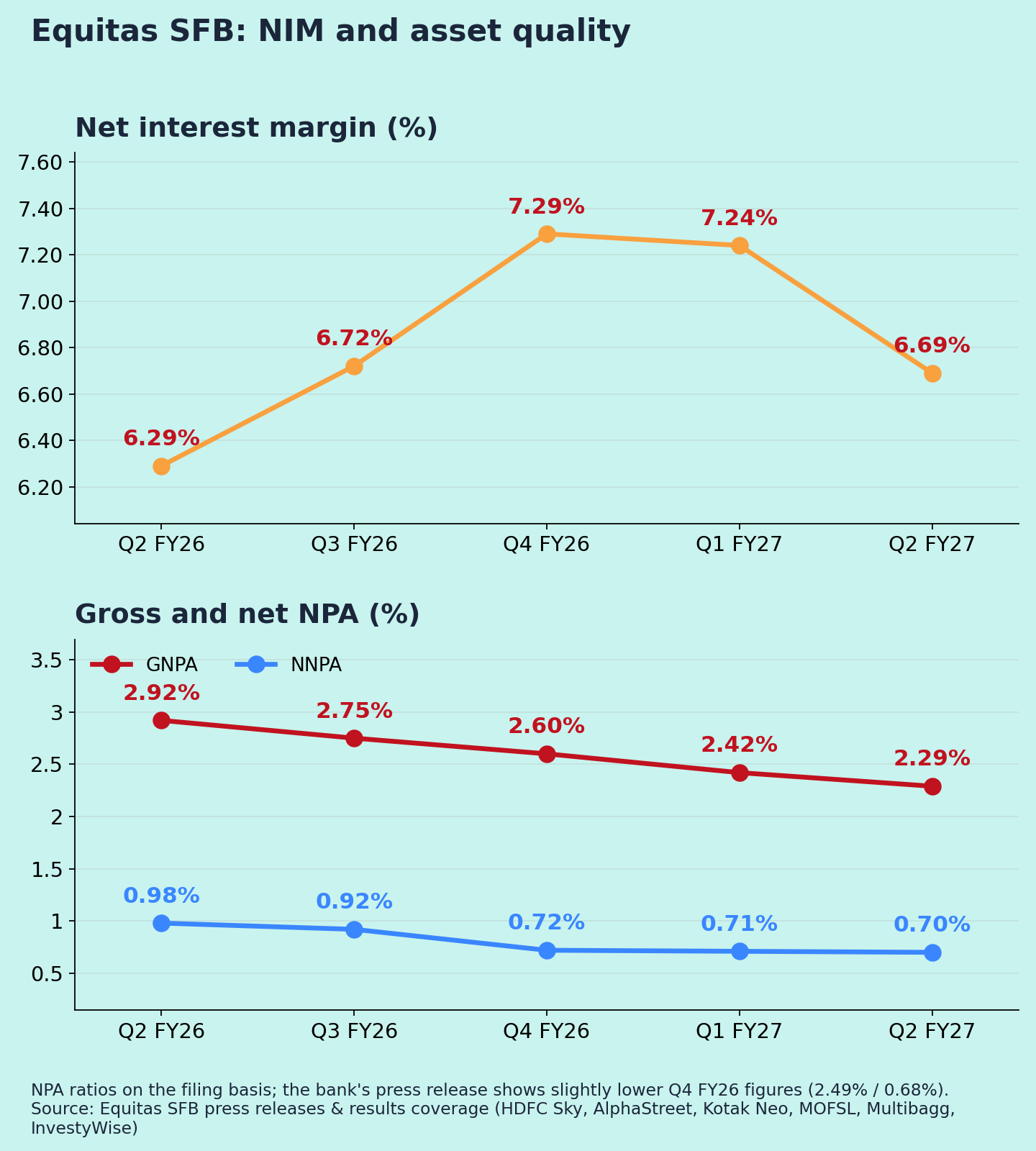
NIM and asset quality (Chart 3)
NIM over five quarters: 6.29% → 6.72% → 7.29% → 7.24% → 6.69%. Management blamed higher funding costs and surplus liquidity. Cost of funds rose to 7.12%.
Asset quality keeps improving: GNPA fell from 2.92% to 2.29%, and net slippages improved to 1.39% [1][2].
Guidance: what changed
- RoA: FY27 guidance raised to 1.35% from 1.2% [2]. At Q4 FY26, management guided ~1.2% for the year and ~1.5% by Q4 [5].
- Loan growth: the FY27 guidance was 20% [10]; it is running at ~30% [1].
- Credit cost: guided at ~1.5% for FY27 [5]; H1 is well below that.
- Capital: ₹500 cr of Tier II bonds raised at a 9.95% coupon [3]. Shareholders have approved an equity raise of up to ₹1,250 cr [11], which could dilute existing holders.
Positives
- Asset quality at multi-quarter best; credit cost below 1% [1]
- Loans +30%, with growth across vehicle, housing and MSE loans [1]
- RoA guidance raised [2]
Concerns
- Leadership vacuum until an RBI-approved successor joins [8]
- NIM down 55 bps, with funding costs rising after the repo hike [2][12]
- Loans growing faster than deposits; CD ratio near 97% [1]
- Profit helped by a one-time provision reversal [2]
Things to track in Q3 FY27
- Name and timing of the new MD & CEO
- NIM recovery as surplus liquidity is deployed
- Deposit growth catching up with loans
- Credit cost without one-offs
Not a buy/sell recommendation. Facts are sourced; opinions are labelled.
Sources [1] InvestyWise – Q2 FY27 press release summary · [2] Multibagg – Q2 FY27 results · [3] ScanX – Q2 FY27 · [4] Investing.com – call transcript · [5] GuruFocus via Yahoo – Q4 FY26 call · [6] TradingView – CEO resignation · [7] Kotak Neo, 29 Oct · [8] Indian Opinion – resignation details · [9] MOFSL – Q1 FY27 note · [10] ScanX – FY27 loan growth guidance · [11] ScanX – Q4 FY26 / QIP approval · [12] SCC Online – RBI policy, 9 Oct 2026 · [13] HDFC Sky – Q2 FY26 · [14] AlphaStreet – Q3 FY26 · [15] Aditya Birla Capital – Q4 FY26 · [16] Quartr – Q1 FY27 · [17] Stockopedia – annual P&L
Charts: (1) last 5 quarters NII & PAT [2][13][14][15][16]; (2) FY23–FY26 NII & PAT [17]; (3) NIM [1][4][5][13][14] and GNPA/NNPA [2][9].